
How to Find Low-Competition Keywords with AI Tips and Prompts


Ranking on Google in 2025 is no longer about stuffing keywords or blindly chasing high-volume terms. The real growth lever is learning how to find low-competition keywords with AI tips and prompts—keywords that real people search for, but most competitors completely ignore.
AI has changed SEO forever. What once took weeks of manual research can now be done in hours with the right prompts, tools, and strategy. From solo bloggers to media brands, those who master AI-assisted keyword discovery are winning faster, ranking smarter, and scaling content with confidence.
In this guide, I’ll show you exactly how experts use AI to uncover hidden, low-competition keywords, validate search intent, and turn them into ranking content—without expensive tools or guesswork.
1. What Are Low-Competition Keywords?
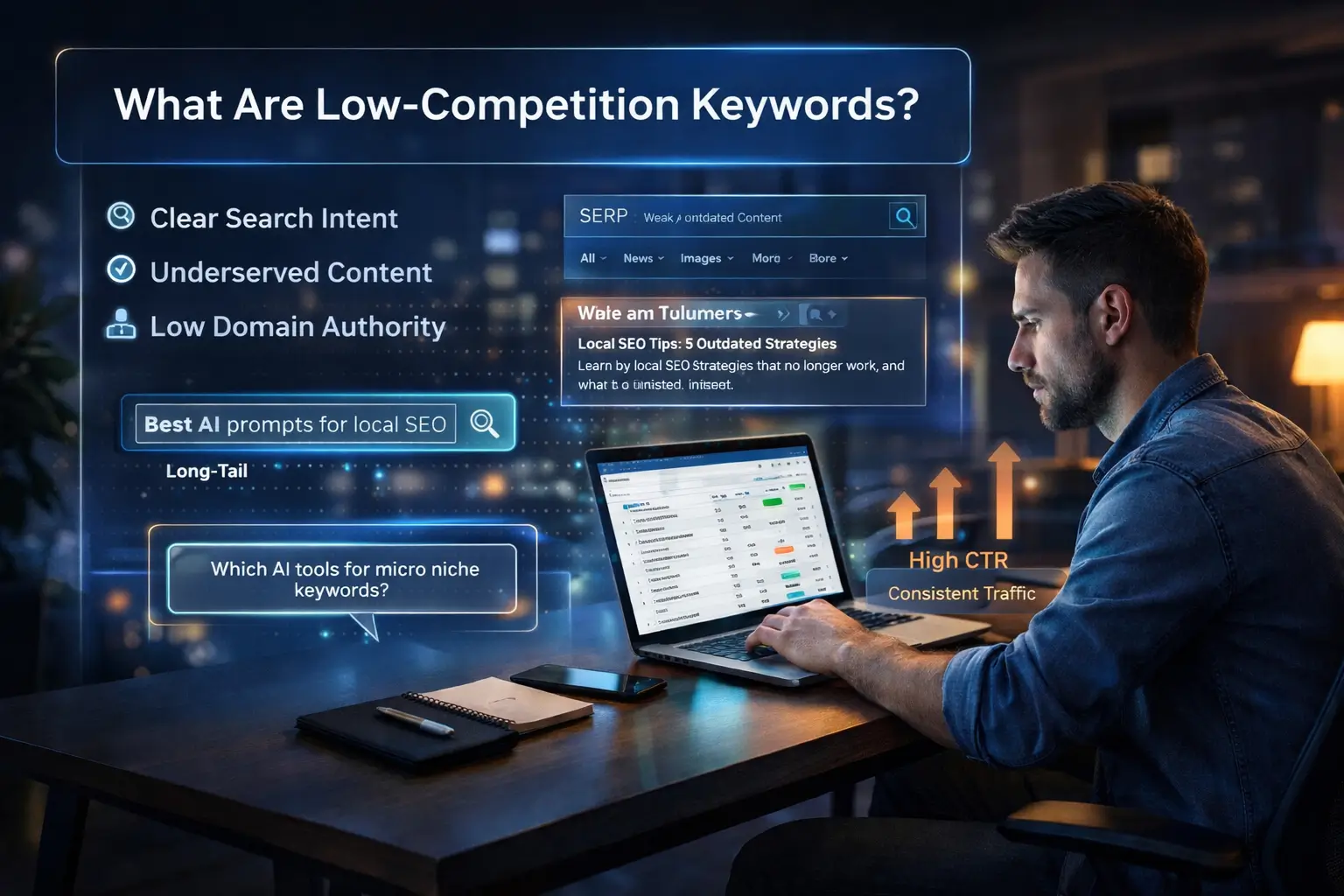
Low-competition keywords are search terms that:
- Have clear search intent
- Are underserved by existing content
- Do not require high domain authority to rank
- Often appear as long-tail or question-based queries
Examples:
- “best AI prompts for local SEO blogs”
- “how to find micro niche keywords with AI”
- “rank math seo keyword research tips”
These keywords may not show massive volume individually, but collectively they drive high-converting, consistent traffic.
2. Why AI Is a Game-Changer for Keyword Research

AI doesn’t replace SEO expertise—it amplifies it.
Here’s why AI excels at low-competition keyword discovery:
- Analyzes patterns, not just numbers
- Understands semantic intent, not exact matches
- Generates keyword ideas humans wouldn’t think of
- Simulates searcher psychology
Tools powered by large language models can uncover:
- Question-based queries
- Problem-aware searches
- Emerging trends before tools show volume
This is why modern SEOs combine AI reasoning with real SERP analysis.
3. How Search Intent Defines Keyword Competition

Competition isn’t just about backlinks—it’s about intent alignment.
There are four main intent types:
- Informational – “how to find keywords with AI”
- Commercial – “best AI keyword research tools”
- Transactional – “buy SEO AI software”
- Navigational – brand-specific searches
Low-competition keywords usually fall under informational or early commercial intent. AI excels at identifying these subtle intent layers.
4. Traditional vs AI-Based Keyword Research
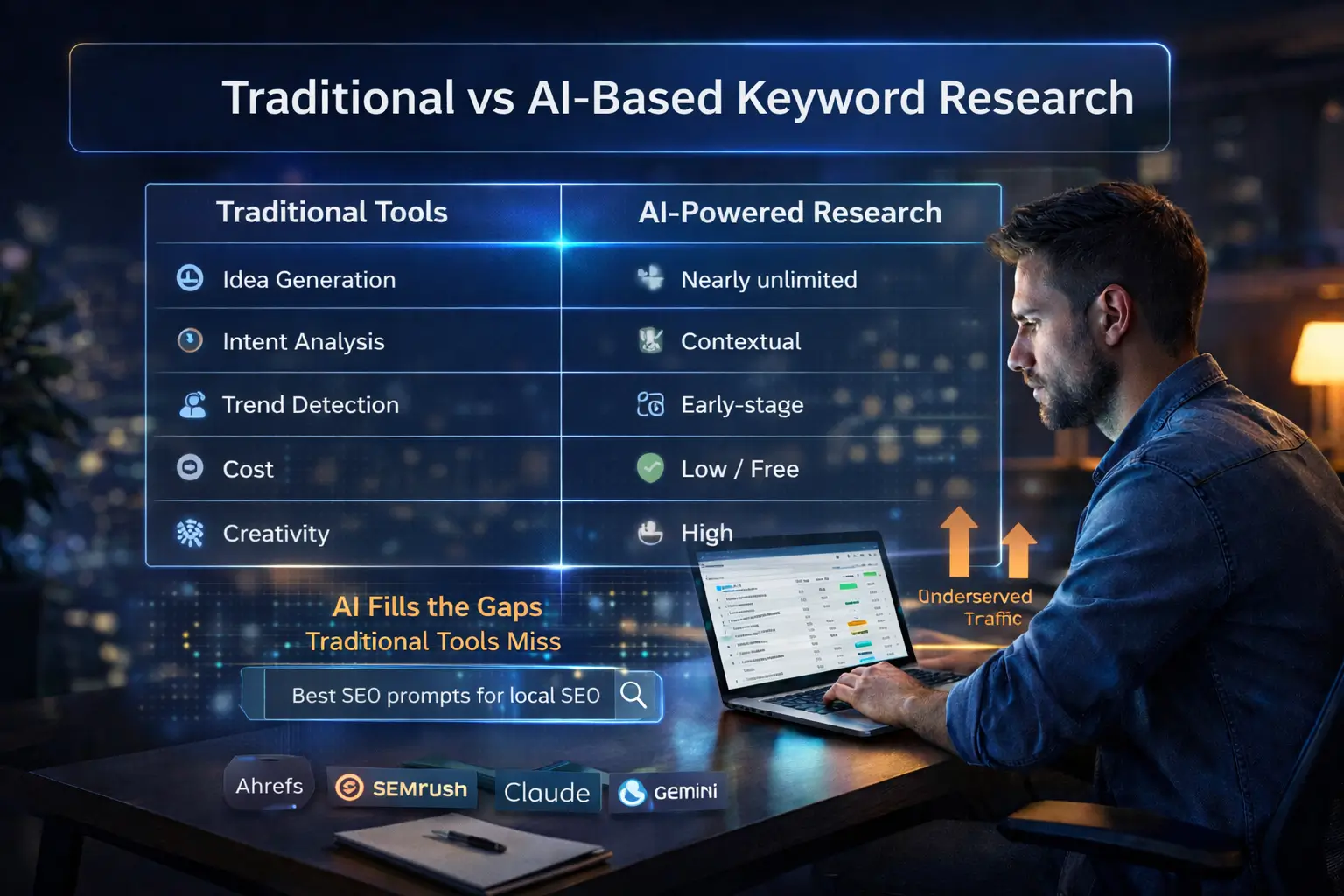
| Aspect | Traditional Tools | AI-Powered Research |
|---|---|---|
| Idea Generation | Limited | Nearly unlimited |
| Intent Analysis | Manual | Contextual |
| Trend Detection | Slow | Early-stage |
| Cost | High | Low / Free |
| Creativity | Low | High |
Traditional tools like Ahrefs and SEMrush are powerful—but AI fills the gaps they miss.
5. Best AI Tools for Finding Low-Competition Keywords

Here’s a practical stack used by SEO professionals:
- ChatGPT / Claude / Gemini – Prompt-based keyword ideation
- Google Search Console – Real impressions with low CTR
- Google Autocomplete & PAA – Human-verified intent
- Rank Math SEO – On-page optimization validation
- Google Trends – Momentum confirmation
AI generates ideas. Google validates them.
6. AI Prompts That Actually Work for Keyword Discovery
Generic prompts fail. Strategic prompts win.
Prompt 1: Hidden Keyword Discovery
“Act as an SEO strategist. List 30 low-competition long-tail keywords related to [topic] that small websites can rank for.”
Prompt 2: Question-Based Keywords
“Generate people-also-ask style questions with low SEO competition for [topic].”
Prompt 3: Buyer Journey Keywords
“Give me keywords targeting beginners, intermediates, and experts searching for [topic].”
These prompts mimic how search engines understand user intent.
7. Using Google SERP + AI Together
AI ideas must face SERP reality.
Validation checklist:
- Are top results forums, Quora, Reddit, or weak blogs?
- Are titles poorly optimized?
- Is content thin or outdated?
If yes, it’s a low-competition opportunity.
AI tells you what to check. Google tells you if it’s worth ranking for.
8. Finding Long-Tail Keywords with AI
Long-tail keywords convert better because they solve specific problems.
AI helps by:
- Expanding seed keywords into conversational phrases
- Identifying pain-point-based queries
- Translating jargon into human language
Example:
Seed: “AI keyword research”
AI-generated long-tail:
- “how to find low competition keywords with ai prompts”
- “ai keyword research for new blogs”
9. Keyword Clustering with AI for Topical Authority
Google ranks topics, not just pages.
AI can group keywords into clusters like:
- Beginner guides
- Tool comparisons
- Use cases
- Mistakes and fixes
Publishing clusters improves:
- Internal linking
- Crawl efficiency
- EEAT signals
This is how authority sites scale fast.
10. Validating Low-Competition Keywords Properly
Before publishing, confirm:
- Search results < 10 highly authoritative domains
- Keyword matches content depth, not just title
- You can write better, clearer, more helpful content
AI gives speed. Validation gives confidence.
11. Real-World Example: From Prompt to Ranking Page
A niche blog used this AI prompt:
“Find low-competition keywords related to AI marketing for beginners.”
Result:
- Keyword: “ai prompts for small business marketing”
- Volume: Low
- Competition: Very low
Within 45 days:
- Page ranked top 5
- 4× higher CTR than generic keywords
- Zero backlinks required
12. Common Mistakes When Using AI for SEO
Avoid these:
- Blindly trusting AI volume estimates
- Publishing without SERP analysis
- Overusing exact-match keywords
- Ignoring internal linking
AI assists strategy—it doesn’t replace SEO thinking.
13. Optimizing Keywords for Rank Math SEO
To fully optimize:
- Use focus keyword in H1, URL, intro
- Add semantic keywords in subheadings
- Optimize FAQ schema
- Improve readability score
- Add outbound authority links
Rank Math rewards clarity and relevance, not keyword stuffing.
14. AI Keyword Research for Google Discover
Discover favors:
- Emotion-driven headlines
- Fresh angles
- Visual storytelling
- Clear topical focus
AI helps rewrite titles for:
- Curiosity
- Timeliness
- Engagement
This increases Discover eligibility dramatically.
FAQs
1. Are AI-generated keywords reliable for SEO?
Yes, when validated with SERP analysis and real search data.
2. Can beginners use AI for keyword research?
Absolutely. AI simplifies complex SEO concepts for beginners.
3. Do low-competition keywords still bring traffic?
Yes. They often bring higher intent and conversion rates.
4. Is AI keyword research better than paid tools?
AI complements paid tools by finding opportunities tools miss.
5. How often should keywords be updated?
Review and refresh every 3–6 months for best results.
Final Takeaways & Call to Action
Learning how to find low-competition keywords with AI tips and prompts is no longer optional—it’s a competitive advantage. AI helps you think faster, deeper, and more strategically, but rankings still reward quality, clarity, and intent alignment.
If you apply the prompts, validation steps, and clustering strategies from this guide, you’ll stop chasing impossible keywords—and start owning rankings that actually convert.